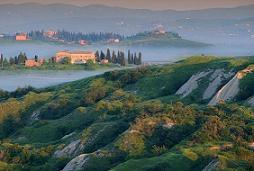
The clay hills of the Crete Senesi roll across southern Tuscany like waves frozen in time, their pale grey and beige surfaces eroded into fantastical shapes. This lunar landscape, known as the Siennese Clays, stretches south of Siena, a region of stark beauty that owes its character to the ancient seabed that once covered this land. The soil here is rich in marine fossils, and the terrain shifts from smooth clay gullies to ravines known as biancane. In spring, the otherwise barren hills are dotted with yellow broom and red poppies, adding colour to the monochrome palette.
Crete Senesi is the area not far from Siena, in the valley of rivers Arbia, Ombrene, and Asso. The area includes the towns like Asciano, Buonconvento, Monteroni d’Arbia, Rapolano Terme and San Giovanni d’Asso.
Crete Senesi means clay of Siena. And right this very unusual composition of the local soil is responsible for the enchanting harmony of colors, which is so typical for this area. It’s a real paradise for every photographer. The medieval towns are spread over the hilltops.
In This Article
The Medieval Towns of the Crete Senesi
The largest town in Crete Senesi, Asciano, has retained its medieval atmosphere. It is felt everywhere, even in the narrow streets, or in ancient churches. Of all these churches you should visit at least basilica Sant’Agata, which construction began in the 11th century, then churches San Francesco and San Bernardino. The best time for your visit to Asciano, is september, when the town hold a historic celebration – Palio dei Ciuchi. Palio dei Ciuchi includes a donkey race and parade, in which the local residents perform in medieval costumes.
On the outskirts of town lies the most important monastery in the province of Siena – Monte Oliveto Maggiore.
This magnificent Benedictine monastery, founded in 1313 by Bernardo Tolomei, is one of the hidden treasures of Tuscany. Its Great Cloister is decorated with a stunning cycle of 36 frescoes by Luca Signorelli and Il Sodoma, depicting the life of Saint Benedict. The frescoes, painted between 1497 and 1508, are considered among the finest Renaissance works in southern Tuscany. The monastery is still active, with around 20 monks living and working within its walls. Visitors are welcome to explore the cloister, the church with its impressive wooden choir stalls, and the library, which contains over 50,000 volumes. The monastery also produces honey, olive oil, and wine, which can be purchased in the small shop near the entrance. Entry to the cloister is free, making it an excellent addition to any Crete Senesi itinerary.
At the south of monastery there is the favorite fortified village – Buonconvento. This charming walled town sits at the confluence of the Arbia and Ombrene rivers and retains its complete medieval fortifications. The town’s Museo d’Arte Sacra houses a remarkable collection of Sienese religious art from the 13th to the 18th centuries, including works by Pietro Lorenzetti and Matteo di Giovanni. Buonconvento’s main street is lined with elegant medieval palaces and traditional trattorias serving local specialities such as pici pasta and wild boar ragout.
Exploring the Lunar Landscape
Another interesting point is Monteroni d’Arbia, the town at whose center lies an impressive mill dates from 1322. The building of mill has been preserved almost complete, including the brick tower and a mill-race.
The best place for relax is Rapolano – wonderful town with spa that served already to Old Etruscans. There are several swimming pools with thermal water in different temperatures.
Crete Senesi is ideal for growing corn and vine. E.g. Brunello di Montalcino comes from this area.
The landscape itself is the main attraction of the Crete Senesi. The grey-blue clay hills, known as biancane, create a surreal, almost extraterrestrial scenery that changes dramatically with the light and seasons. In winter, the bare hills take on a silvery grey hue under the low sun, while spring transforms the scene with patches of bright green wheat and the golden flowers of broom. Summer bakes the clay into pale, cracked shapes, and autumn brings warm amber tones. The best way to experience the landscape is by driving the SP438 road between Asciano and San Giovanni d’Asso, which winds through the heart of the region with numerous viewpoints and lay-bys for photography. Walking and cycling are also excellent options, with several marked trails crossing the clay hills. The area is also known for its high-quality Pecorino cheese, which holds DOP status and is produced from sheep grazing on the herb-rich pastures of the Crete. The Formaggio Tiberto cheese shop near Asciano offers free tastings of local cheeses paired with the wines of the region, including Brunello di Montalcino and Rosso di Montepulciano.
Exploring the Clay Hills
The Crete Senesi covers approximately 200 square kilometres south of Siena, best viewed along the SP438 road between Asciano and San Giovanni d’Asso. The Abbey of Monte Oliveto Maggiore, a Benedictine monastery, features frescoes by Signorelli and Sodoma in its Great Cloister, entry free. The town of Asciano hosts a weekly market on Thursday mornings. The Pecorino cheese produced here has DOP status. The Formaggio Tibetano shop near Asciano offers free tastings of local cheeses and wines.
Would you explore the lunar landscape of Crete Senesi or the rolling vineyards of Chianti? 🌄
Explore all our Italy travel guides, from the Dolomites to Sicily.
Explore More
If you enjoyed this article, you might also like:
