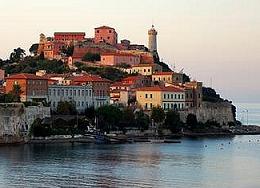
Portoferraio curves around a natural harbour on the northern coast of Elba. White buildings climb the hillsides beneath the gaze of ancient fortresses. Napoleon spent his first exile here, and his presence lingers in the Villa dei Mulini and the Villa San Martino. Ferries from the mainland arrive daily, disgorging travellers eager to explore the island. The old town offers narrow streets lined with shops selling local wine and olive oil. Beachgoers head to Le Ghiaie for clear waters just a short walk from the port. The Medici fortifications crown the hilltops, offering panoramic views across the Tyrrhenian Sea. Portoferraio balances the roles of working port and holiday destination with an ease that only Italian towns seem to manage.
Portoferraio is the largest and capital city of the Italian island of Elba. It lies on the northern coast of the island, about 25km from the mainland. In 2010 it has about 12,000 inhabitants. There is a large port and many monuments from the 16th century. The old port was already used by Etruscans. At the modern waterfront you can visit any of the restaurants, cafes and pizzerias. You should not forget to taste the local seafood specialties, and traditional seafood dishes. At each step there is a small shop with souvenirs and craftwork.
In the city you can walk through the narrow cobbled streets full of stairs and steps. Portoferraio is also known for its numerous old churches. Since the city was reconstructed in 1548 in a military style, its main attractions are fortresses Stella, Falcone and Bastion della Linguella. Another interesting sights are the Church of Reverend Mercy and Napoleon’s museum. In the old city there is also one the residences of Napoleon. If you rent a car or a motorcycle in Portoferraio, you can take a circuit around the island and visit some of the most interesting places, including hidden and remote beaches. Portoferraio has good ferry connections with Livorno, Piombino and with many other islands of the Tuscan archipelago.
In This Article
Napoleonic Legacy on Elba
Napoleon Bonaparte’s exile on Elba from May 1814 to February 1815 left an indelible mark on Portoferraio. The Emperor chose this port city as his temporary capital and set about improving the island’s infrastructure and governance. His two main residences, the Villa dei Mulini in town and the Villa San Martino in the hills outside, are now museums dedicated to his stay. Villa dei Mulini, perched on a rocky promontory overlooking the sea, contains Napoleon’s study, library, and bedroom with original furnishings. Villa San Martino, set among terraced gardens, served as his summer retreat and features frescoed rooms depicting scenes from his campaigns. Guided tours in multiple languages explain the daily life of the exiled Emperor, who governed Elba as a miniature kingdom complete with its own army, navy, and flag. The museums house personal artefacts including his death mask, campaign furniture, and correspondence from the period. A commemorative path traces the routes Napoleon walked through Portoferraio, linking the two villas via the old town. History enthusiasts will find that two hours easily disappears among these evocative rooms and their stories of ambition, defeat, and resilience.
Beaches and Water Activities
The coastline around Portoferraio offers some of the best beaches on Elba, each with its own character. Le Ghiaie, a pebble beach just a ten-minute walk from the ferry terminal, is the most accessible option with crystal-clear waters perfect for snorkelling. A short drive west leads to Biodola, a sweeping crescent of golden sand backed by Mediterranean scrub, where watersports centres offer windsurfing, paddleboarding, and kayak rentals. Further east, the beach at Capo Bianco takes its name from the striking white cliffs that frame its turquoise waters. Scuba divers flock to Elba for its underwater wonders: ancient shipwrecks, granite reefs teeming with marine life, and submerged caves. Dive centres throughout Portoferraio offer equipment rental and courses for all levels, from introductory dives to advanced certifications. The waters of the Ligurian Sea boast remarkable visibility, often exceeding thirty metres. Families appreciate the gentle gradient of Portoferraio’s main beaches, where children can paddle safely while parents relax at beachside cafes serving fresh seafood and chilled local white wine. For something different, boat excursions depart daily from the port, circling the island with stops at hidden coves accessible only from the sea.
Exploring the Tuscan Archipelago
Portoferraio serves as the gateway to the entire Tuscan Archipelago National Park, a protected marine area encompassing seven main islands. Regular ferries and hydrofoils connect Elba to the smaller islands of Capraia, Giglio, and Pianosa, each offering a distinct experience. Capraia, the wildest of the archipelago, features a dramatic coastline of volcanic cliffs and a small harbour village where time moves slowly. Giglio boasts some of the best hiking in the region, with trails winding through vineyards and chestnut forests to panoramic viewpoints. Pianosa, flat and almost treeless, tells a different story as a former prison island now open to guided tours of its abandoned penitentiary and untouched beaches. Closer to Portoferraio, the island of Montecristo inspired Alexandre Dumas’s novel “The Count of Monte Cristo” and remains a strict nature reserve accessible only by permit. Day trips from Portoferraio allow visitors to explore multiple islands within a single holiday, with ferries running seasonally from April through October. The archipelago’s waters are among the cleanest in the Mediterranean, making every beach and snorkelling spot a genuine pleasure.
View Portoferraio \u2011 the largest and capital city of the Italian island of Elba in a larger map
Would you visit Elba for its beaches or for its Napoleonic history? \u{1F3DB}\u{FE0F}
Explore all our Italy travel guides, from the Dolomites to Sicily.
Explore More
If you enjoyed this article, you might also like:
