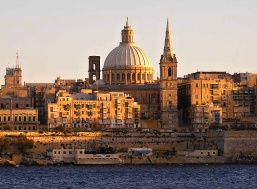
Golden limestone glows in the Mediterranean sun as you approach Valletta, a fortified city built by the Knights of St. John. The streets form a grid of narrow lanes that climb steeply from the Grand Harbour, each corner revealing another Baroque palace, another ornate church, another sweeping sea view. St. John’s Co-Cathedral conceals a breathtaking interior of gilded arches and Caravaggio masterpieces behind its plain facade. The upper Barrakka Gardens offer a panoramic terrace where the cannon fires daily at noon. Valletta packs more history per square meter than almost any other European capital, all wrapped in sunlight and sea breezes.
Valletta is the capital city of Malta, situated between two magnificent natural harbours: Marsamxett Harbour and Grand Harbour. From all sides, it is protected by strong walls that made it the best defensive city in the 17th century. The city is named after Jean Parisot de la Valette, who succeeded in defending the island from an Ottoman invasion in 1565. It is a city full of historical monuments. The centre of Valletta is formed by a circular square with the Triton Fountain, a striking bronze sculpture that welcomes visitors arriving from the city gate.
The main entrance to the fortifications of Valletta is the City Gate, designed by the renowned architect Renzo Piano as part of a modern redevelopment of the entrance area. Just behind it is Republic Street, which stretches across the peninsula to its furthest end, to Fort St. Elmo. On Republic Street, you will find major historical sights, most shops, and many of the city’s best cafes. Beautiful churches and palaces stand in contrast with the military look of the city. Rising and falling streets are lined with houses decorated with beautiful bay windows and wooden balconies painted in vibrant shades of green, red, and blue.
What to see in Valletta?
When you go to Valletta, you should not miss its sights that are definitely worth seeing. Among the most interesting is one of the oldest buildings in town: the Grandmaster’s Palace from the 16th century. Today it houses the Maltese parliament, the president’s office, and the Palace State Rooms museum. The palace features a stunning armory with weapons and armour spanning four centuries.
Another major attraction is the fortification of Fort St. Elmo, which played an important role in defending the island during the Great Siege of 1565. It is now home to the National War Museum. St. James Cavalier is the strongest fortification of Valletta, now a cultural centre with a cinema, theatre, and concert hall. A memorial to victims of the Second World War can be found in the Lower Barrakka Gardens, a peaceful green space with neoclassical monuments overlooking the harbour.
View Valletta – lots of historical sights in the capital city of Malta in a larger map
St. John’s Co-Cathedral and Caravaggio Masterpieces
St. John’s Co-Cathedral is the jewel of Valletta and one of the finest examples of Baroque architecture in Europe. Built between 1573 and 1578 by the Order of the Knights of St. John, its exterior is deliberately plain and fortress-like, concealing an interior of breathtaking opulence. The floor is a mosaic of inlaid marble tombstones commemorating hundreds of knights, each one a work of art in itself. The vaulted ceiling is covered with paintings by Mattia Preti depicting scenes from the life of St. John the Baptist.
The cathedral’s Oratory houses two masterpieces by Caravaggio: “The Beheading of Saint John the Baptist” and “Saint Jerome Writing.” The Beheading is Caravaggio’s largest work and the only painting he ever signed, his name visible in the blood flowing from the saint’s neck. The dramatic chiaroscuro, the raw emotion on every face, and the brutal realism of the scene represent Baroque art at its most powerful. An audio guide explains the symbolism and history behind each chapel, including the eight oratories dedicated to the eight Langues (national groups) of the Knights. Allow at least 90 minutes for a thorough visit. Tickets are best purchased online in advance, as queues can stretch around the block during peak cruise ship season.
The upper Barrakka Gardens and Fortifications
The upper Barrakka Gardens sit at the highest point of Valletta’s fortifications, offering a panoramic terrace with what many consider the finest view of the Grand Harbour. From here, you can see the Three Cities (Vittoriosa, Senglea, and Cospicua) across the water, the breakwater protecting the harbour entrance, and the open Mediterranean beyond. The gardens are laid out in formal Italian style with shady arcades, fountains, and statues of Maltese historical figures. The daily noon cannon salute, fired from the Saluting Battery below the gardens, is a tradition dating back to British colonial rule and draws a crowd every day.
Descending from the gardens, the Barrakka Lift takes visitors down to the Lascaris Wharf in under 30 seconds. At the base of the fortifications, stroll along the harbour wall past the marina filled with superyachts and traditional Maltese fishing boats. The Siege Bell War Memorial, a massive bronze bell cast in 1992, commemorates the victims of the World War II siege of Malta. The Lower Barrakka Gardens, smaller and quieter than the upper terrace, feature the neoclassical Temple of Bellona and peaceful benches shaded by palm trees. Valletta’s fortifications, a UNESCO World heritage site in their own right, wrap the entire peninsula in layers of bastions, ramparts, and ditches that reward exploration at every turn.
Would you start your Valletta visit with the cathedral treasures or the harbour views from the gardens? 🏛️
Explore all our Malta travel guides, from Valletta bastions to Gozo cliffs.
Explore More
If you enjoyed this article, you might also like:
