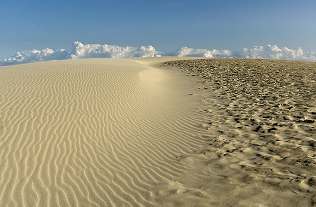
S\u0142owi\u0144ski National Park is one of Poland’s most extraordinary natural landscapes, a UNESCO World heritage coastal reserve on the Baltic Sea whose defining feature is its shifting sand dunes, massive golden mountains of sand up to 42 metres high that move inland at a rate of 3 to 10 metres per year, slowly consuming the pine forest in a geological drama you can witness with your own eyes. Located on Poland’s northern coast between \u0141eba and Rowy, S\u0142owi\u0144ski is a place of surreal, almost desert-like beauty: standing atop the \u0141\u0105cka Dune, the largest moving dune in Europe, you see nothing but sand on one side and the blue Baltic on the other, a landscape that feels more Sahara than Poland.
In This Article
Quick Facts: S\u0142owi\u0144ski National Park, Poland
- Best time to visit: May-September for the best weather and full visitor facilities; the shifting dunes are most dramatic in summer when the sand is dry; access times for the dunes may be restricted during bird breeding season in parts of the reserve
- Top attraction: The moving dunes, particularly the \u0141\u0105cka Dune (42m) and the Czo\u0142pi\u0144ska Dune, accessible via marked trails from \u0141eba
- How to get there: ~1.5 hours from Gda\u0144sk by car; the main entry point is \u0141eba, a popular seaside resort with plentiful accommodation; from \u0141eba, the dunes are a pleasant 5.5km walk or bike ride through pine forest, or accessible by electric buggy
- Entry fee: Small daily fee (approximately PLN 8 to 10) to enter the park; bike rental is highly recommended in \u0141eba
- UNESCO status: Designated a UNESCO Biosphere Reserve in 1977
- Best for: Nature lovers, photographers, families, and anyone who wants to see a genuinely unusual landscape
The Living Dunes: Europe’s Shifting Sands
The dunes of S\u0142owi\u0144ski are created by a unique combination of wind, sea, and vegetation. Westerly winds pick up sand from the wide, exposed beaches and carry it inland, where it accumulates into massive crescent-shaped (barchan) dunes before spilling over the crest and slowly burying the forest on the landward side. This process has been happening for thousands of years, but the movement accelerated dramatically in the 18th century when deforestation removed the natural windbreak.
The most dramatic experience is walking to the top of the \u0141\u0105cka Dune, which rises 42 metres above the surrounding terrain. From the summit, the view is otherworldly: a golden sand sea stretching to the horizon on one side and the glittering Baltic Sea on the other. The dunes are constantly changing shape and position, so every visit offers a slightly different landscape. You can watch sand trickle down the slip face, slowly engulfing the edges of the pine forest below.
Lakes, Forests and Coastal Wildlife
Beyond the dunes, the park protects a rich mosaic of coastal lakes including \u0141ebsko, Gardno, and Do\u0142gie Wielkie. These shallow, brackish lakes provide critical habitat for over 260 bird species, including cranes, sea eagles, and numerous migratory waterfowl. The contrast between the golden dunes, the silver lakes, and the deep green pine forest is genuinely haunting and has inspired generations of Polish artists and writers.
The park’s forests are a mix of pine, beech, and oak, with boardwalks allowing visitors to explore the wetland areas without disturbing the fragile ecosystem. Observation towers near the lakes provide excellent birdwatching opportunities. The park also protects the unique “white swamp” near the Czo\u0142pi\u0144ska Dune, a rare peatland habitat formed by the dune’s slow movement blocking water drainage.
S\u0142owi\u0144ski National Park (S\u0142owi\u0144ski Park Narodowy) is located in Pomeranian Voivodeship in northern Poland, on the Baltic coast, between \u0141eba and Rowy. It covers 32.5km of coastline and is 186.18 km2 large. There are around 140km of walking tourist trails in S\u0142owi\u0144ski National Park. By the lakes there are some observation towers and along the trails one can find benches and resting places. Around the park there are many hotels and camp sites, especially in \u0141eba.
S\u0142owi\u0144ski National Park is visited by thousands of tourists, fond of the beauty and variability of its landscape. In order to maintain one of the most precious tie of indigenous nature, which undoubtedly is The Land of Water, Wind and Sand, there have been allocated only selected areas of the Park for tourism practicing as well as special regulations have been introduced for sightseeing there.
Image made by michbet6464
View S\u0142owi\u0144ski National Park in Poland in a larger map
Have you walked the shifting sands of S\u0142owi\u0144ski or explored Poland’s Baltic coast? Share your dune experiences and photos in the comments, I’d love to hear what it feels like to stand on Europe’s largest moving dune! \uD83C\uDFDC\uFE0F
Explore all our Poland travel guides, from Kraków square to the Tatra Mountains.
Explore More
If you enjoyed this article, you might also like:
