Ravenna was once the capital of the Western Roman Empire and its golden mosaics remain as proof of that glorious past. You step into a small unassuming church and look up to find every surface covered in glittering tiles. Emperors and saints stare down from the walls their robes made of thousands of tiny pieces of glass and gold leaf. The light changes throughout the day and the mosaics shift with it catching fire at sunset. eight UNESCO World heritage sites sit within walking distance of each other. Ravenna does not shout about its treasures but it does not need to.<\/strong><\/p>
Back during the 5th century, the ancient city of Ravenna<\/strong> was made the capital of what has become known as the West Roman Empire. Today, the city is home to 8 major UNESCO heritage sites that date back to the 5th century. Long before it existed as a city, the area where Ravenna sits today was nothing more than a lagoon with canals spreading throughout the region. The lagoon and canals were filled in and city of Ravenna was soon realized.<\/p>
<\/a>
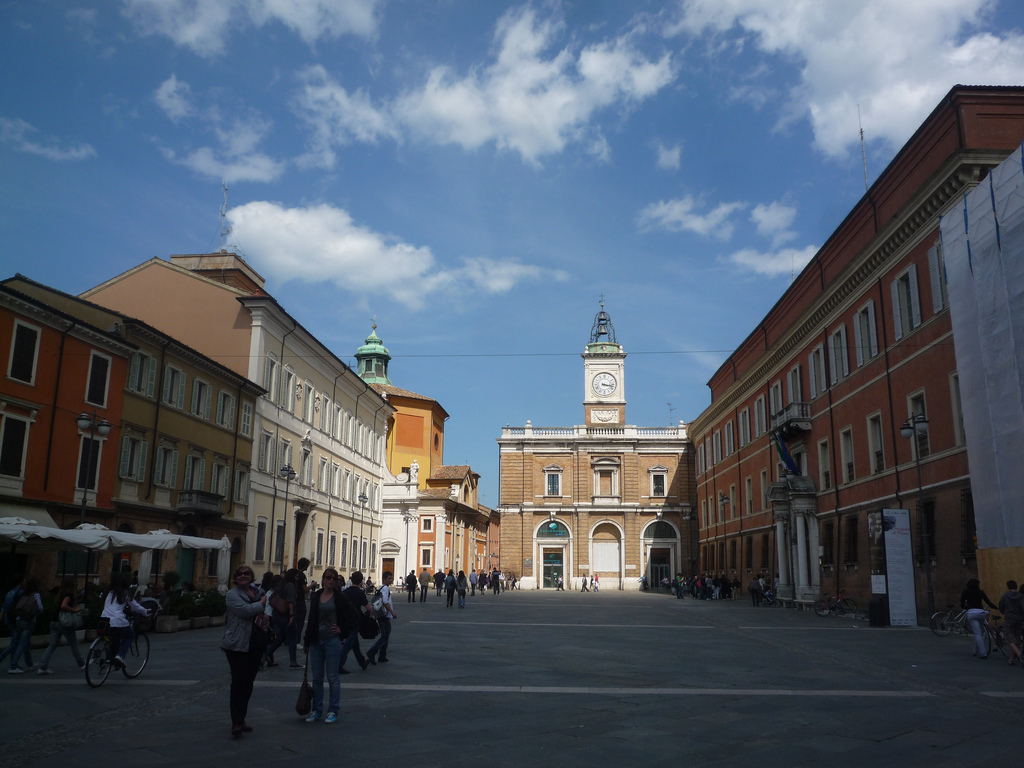
Piazza del Popolo, Ravenna, Italy by freshcreator<\/a><\/p>
The Byzantine Mosaics of Ravenna<\/h2>
The mosaics of Ravenna are widely considered the finest examples of Byzantine mosaic art surviving anywhere in Europe, and they are the city’s defining cultural treasure. The Mausoleo di Galla Placidia, dating from the 5th century, contains some of the oldest and most breathtaking mosaics, with deep blue ceilings covered in golden stars and intricate Christian symbolism. The starry sky mosaic in the mausoleum’s dome is particularly famous, with its depiction of the night sky as it would have appeared on the evening of the mausoleum’s consecration. The basilica di San Vitale, consecrated in 547, represents the pinnacle of Byzantine mosaic art, with its magnificent apse mosaics depicting Emperor Justinian and Empress Theodora accompanied by their courtiers. These mosaics are remarkable not only for their artistic quality but also for their historical value, as they provide some of the most detailed contemporary depictions of Byzantine imperial court life. The basilica di Sant’Apollinare Nuovo features a continuous mosaic frieze running along both walls of the nave, depicting processions of saints and virgins against a golden background. What makes Ravenna’s mosaics truly extraordinary is their completeness, with entire interior surfaces of multiple buildings still covered in their original 5th and 6th century decoration.<\/p>
Ravenna’s UNESCO World heritage Monuments<\/h2>
Ravenna’s eight UNESCO World heritage monuments are concentrated within a remarkably small area, making it possible to visit all of them on foot in a single day. The Neonian Baptistery, also known as the Baptistery of the Orthodox, features a stunning mosaic ceiling depicting the baptism of Christ surrounded by the twelve apostles. Nearby, the Battistero degli Ariani, built during the reign of the Ostrogothic king Theodoric the Great, offers a contrasting perspective with its Arian Christian imagery. The basilica di Sant’Apollinare in Classe, located a short distance from the city centre in the ancient port of Classe, is another UNESCO site that should not be missed, with its magnificent apse mosaic of Saint Apollinaris surrounded by sheep in a paradisiacal landscape. The Mausoleum of Theodoric, built from massive blocks of Istrian stone without mortar, is a remarkable example of Ostrogothic architecture and stands apart from the city’s Byzantine-influenced buildings. A combined ticket covering five of the main monuments costs 12 euros and is valid for seven days, allowing visitors to explore at a relaxed pace. Each monument offers a different glimpse into Ravenna’s layered history, from its Roman origins through its Ostrogothic and Byzantine periods, creating a unique open-air museum of late antique and early medieval art.<\/p>
Dante’s Final Resting Place in Ravenna<\/h2>
Ravenna holds a special place in literary history as the final home of Dante Alighieri, the great Italian poet who authored the Divine Comedy. After being banished from his native Florence, Dante spent his final years in Ravenna under the protection of Guido Novello da Polenta, the city’s ruler. The poet died in Ravenna in 1321, and his tomb remains in the city to this day, housed in a small neoclassical monument adjacent to the basilica di San Francesco. The Dante Museum, located nearby, contains manuscripts, illustrations, and artefacts related to the poet’s life and work. The connection between Dante and Ravenna adds another layer of cultural significance to a city already rich in historical treasures. Each year, on the anniversary of Dante’s death in September, the city holds commemorative events that draw literary scholars and enthusiasts from around the world. Ravenna’s ability to preserve and honour such a diverse range of cultural heritage, from Roman imperial capitals to Byzantine mosaics to Dante’s legacy, makes it one of the most fascinating and rewarding destinations in all of Italy.<\/p>
Have you ever walked into a building and been stopped in your tracks by its beauty? Where was it? ✨<\/strong><\/p>
Explore more Italy travel guides<\/a>.<\/em><\/p>
Explore all our Italy travel guides, from the Dolomites to Sicily.
Explore More
If you enjoyed this article, you might also like:
