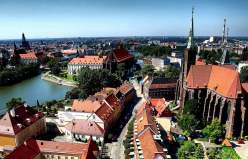
Wrocław is one of Poland’s most vibrant and architecturally stunning cities, a colourful tapestry of Gothic spires, Baroque palaces, and modernist landmarks spread across 12 islands and over 100 bridges. Known as the “Venice of Poland,” this Lower Silesian gem has reinvented itself as a cultural powerhouse, crowned European Capital of Culture in 2016 and widely regarded as one of the best-value city breaks in Central Europe.
In This Article
Quick Facts: Wrocław
- Best time to visit Wrocław: May-September for mild weather and outdoor festivals; December for one of Poland’s most atmospheric Christmas markets
- Top attractions in Wrocław: Market Square (Rynek), Cathedral Island (Ostrów Tumski), Centennial Hall (UNESCO), and the Wrocław dwarfs
- How to get to Wrocław: Wrocław Copernicus Airport (WRO) with budget flights from across Europe; ~3.5 hours from Warsaw by train; ~4 hours from Berlin by bus
- Currency: Polish złoty (PLN), excellent value compared to Eurozone destinations
- Best for: Architecture lovers, history buffs, foodies, and budget-conscious city-breakers
Why Visit Wrocław in 2026?
Wrocław’s Market Square (Rynek) is arguably the most beautiful in Poland, an explosion of pastel-coloured merchant houses, the ornate Gothic Old Town Hall, and a lively café culture that spills onto the cobblestones year-round. The city spans the Oder River and its tributaries, with 12 islands connected by 130 bridges, more than Venice. This unique geography gives Wrocław a distinct character, with water views appearing around every corner and a relaxed pace of life that sets it apart from Poland’s other major cities.
Cathedral Island, known as Ostrów Tumski, is the oldest part of the city, a tranquil quarter of cobbled lanes, gas-lit streets, and magnificent ecclesiastical architecture including the Cathedral of St John the Baptist and the Church of the Holy Cross. Come at dusk to watch the lamplighter still lighting the gas lamps by hand, a tradition unchanged for over a century. This enchanting ritual, one of the last of its kind in Europe, connects modern visitors directly to the city’s medieval past. Wrocław is the fourth largest city in Poland, with over 630,000 residents, located in the south-western part of the country on the River Oder. Over the centuries, the city has been part of Poland, Bohemia, Austria, Prussia, and Germany, a complex history reflected in its remarkably diverse architecture.
Wrocław’s Cultural Highlights
Centennial Hall is a UNESCO World heritage site and a pioneering example of reinforced concrete architecture, built in 1913 to mark the centenary of the Battle of Leipzig. Designed by Max Berg, the hall’s enormous dome was the largest of its kind when constructed, and it remains a triumph of modern engineering. The surrounding Szczytnicki Park features a stunning Japanese Garden, a multimedia fountain that puts on spectacular evening shows, and numerous walking paths that make it a favourite destination for both locals and visitors.
The Panorama of Racławice is a monumental 114-metre-long circular painting depicting the 1794 Battle of Racławice, one of only a handful of surviving 19th-century panoramas in the world. The painting surrounds the viewer completely, creating an immersive historical experience that has no equivalent in modern cinema. The National Museum houses one of Poland’s finest collections of Silesian art, from the medieval period through to contemporary works, while the Four Denominations District showcases the city’s historic religious diversity, with a Catholic church, an Orthodox church, a Protestant church, and a synagogue all within a few hundred metres of each other.
The Wrocław Dwarfs, known as Krasnale, are over 400 tiny bronze dwarf statues hidden throughout the city, a whimsical scavenger hunt that began as a symbol of the anti-communist Orange Alternative movement. Each dwarf has its own name, character, and story, and finding them has become one of the city’s most popular activities for visitors of all ages. The dwarfs represent the city’s playful spirit and its history of peaceful resistance against authoritarian rule.
What to See in Wrocław: A Practical Guide
The Rynek, or market square, with its 14th-century Town Hall is the heart of the city. St Elisabeth’s Church offers a 91-metre tower climb with panoramic views. The Centennial Hall (Hala Stulecia) by Max Berg is a World heritage Site. Other must-see attractions include the Multimedia Fountain, Szczytnicki Park with its Japanese Garden, the Zoo, the Botanical Garden, Ostrów Tumski with Wrocław Cathedral, the Panorama Racławicka, Plac Grunwaldzki, Wrocław Palace, and the White Stork Synagogue. The city’s zoo is one of the largest in Poland and features the Afrykarium, a unique oceanarium dedicated to African aquatic ecosystems.
Wrocław’s food scene has exploded in recent years, with traditional Polish milk bars sitting alongside Michelin-recommended restaurants. Local specialities include pierogi, żurek soup, and the Silesian potato dumplings known as kluski śląskie. The city’s craft beer scene is equally vibrant, with numerous microbreweries and beer halls offering tastings and tours. With budget flights connecting Wrocław to cities across Europe and excellent rail links to Warsaw, Berlin, and Prague, this Polish gem is more accessible than ever and offers exceptional value for money compared to Western European capitals.
View Wrocław – plenty of cultural and architectural attractions in Poland in a larger map
Planning a trip to Wrocław or exploring historic Polish cities? Share your favourite Wrocław discoveries in the comments below, especially if you’ve spotted the dwarfs!
Explore all our Poland travel guides, from Kraków square to the Tatra Mountains.
Explore More
If you enjoyed this article, you might also like:

Pro tip for anyone visiting Wroclaw: try to arrive on a weekday if possible. We went on a quiet day and had the place almost to ourselves. Made the whole experience so much more intimate and enjoyable.